
After Builders Clean in London: What's Actually Included (and What Most Quotes Leave Out)

Alexandra Iftimi
Head of Housekeeping Services
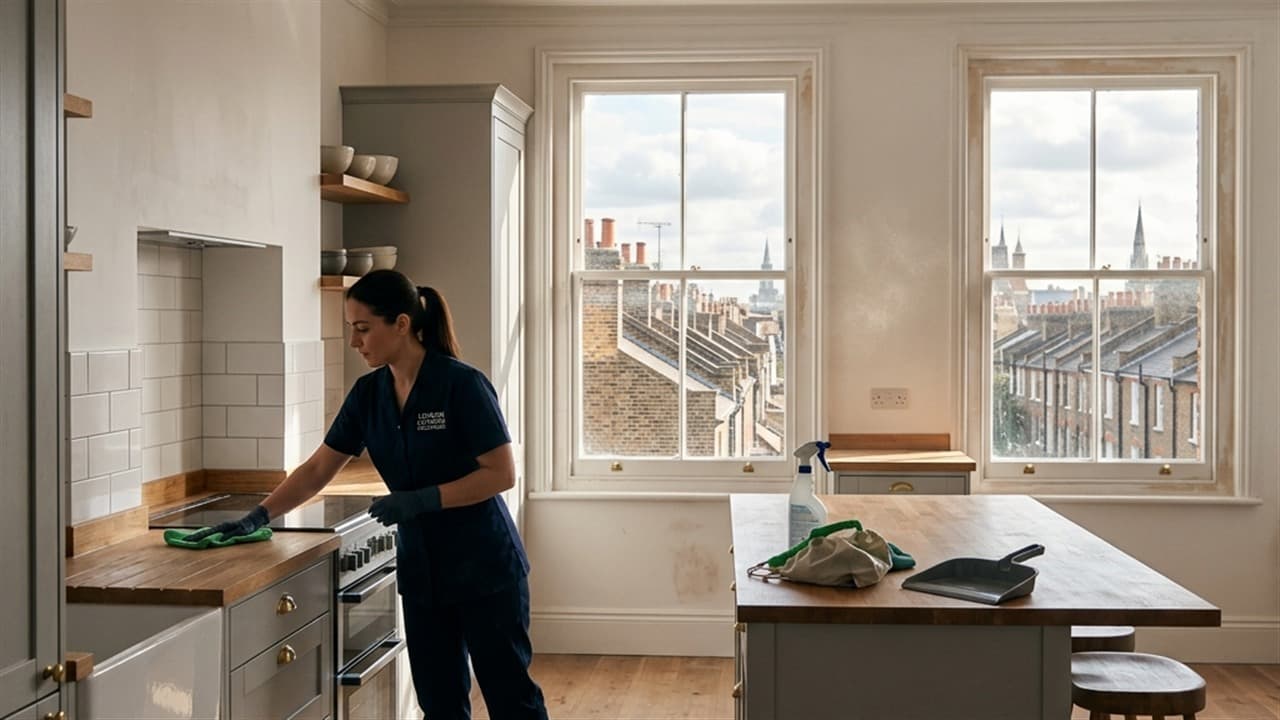
The builders pack up, the skip gets collected, and someone on site runs a broom around before they leave. That's a builders clean. It's not nothing — but it's also not what most people mean when they say they want the property "clean" after a renovation.
We get called in after this stage constantly. Usually by someone standing in a finished loft conversion or a freshly tiled kitchen, looking at a fine grey film over every surface, wondering why the place still feels like a building site three days after the building work technically finished.
Here's what's actually involved in a proper after-builders clean, why the timing of it matters more than most people realise, and why two quotes for the same job can land £200 apart and both be reasonable.
A broom clean and a post-construction clean are different jobs
Most building contracts include a basic clear-up at the end — sweeping floors, bagging offcuts, wiping down obvious mess. That's a broom clean, sometimes called a "builders clean" in the trade, and it's meant to leave the site tidy enough to hand back, not liveable.
It rarely involves dusting above eye level, doesn't touch the inside of light fittings or extractor fans, and almost never deals with the fine residue that settles into grout lines, window frames, and skirting boards. The builders aren't being lazy — clearing construction debris and deep-cleaning a property are two different skill sets, and most building teams are good at the first and not equipped for the second.
A genuine post-construction clean is the stage after that: the one that gets a property from "the building work is finished" to "I'd happily host dinner here tonight." It's a different scope, usually takes longer than people expect, and uses different methods because construction dust doesn't behave like household dust.
Construction dust is the part nobody warns you about
Plasterboard dust, sawdust, and brick dust are fine — genuinely fine, in the particle-size sense — and that's exactly the problem. Ordinary household dust mostly stays where it lands. Construction dust is light enough to stay airborne for hours, abrasive enough to scratch surfaces if you wipe it the wrong way, and it gets into places you wouldn't think to check: inside drawer runners, behind radiators, on top of door frames, in the gap between a worktop and the wall.
The bit that catches people out is timing. Dust that's been disturbed during the final days of a build keeps resettling for 24 to 48 hours after the work physically stops. If you clean too early — say, the morning after the last fix is done — you'll do a thorough job and still have a visibly dusty room again by the next evening, because everything that was still suspended in the air has had time to land.
We generally recommend leaving at least a full day, ideally two, after the last disruptive work (sanding, cutting, any drilling) before booking the deep clean. If you're on a tight handover deadline and can't wait, it's still worth doing — you'll likely just need a quick top-up wipe a day or two later, which is far less work than redoing the whole clean.
What a proper after-builders clean actually covers
Room by room, this is what should be happening — not "we clean everything," but the specific tasks that separate a post-construction clean from a normal one.
Walls, ceilings, and light fittings. Cobwebs and dust in corners, wipe-down of walls at the level dust actually settles (which is higher than people expect — door frames, the tops of skirting boards, picture rail height), and the inside of light fittings and lampshades, which collect a surprising amount of fine dust through the fitting itself.
Windows and frames. This is where paint flecks, masking tape residue, and silicone smears end up, especially if there's been any work near the windows — new frames, painting, or re-glazing nearby. Standard glass cleaning won't shift dried paint or silicone; it needs a blade or solvent approach that doesn't scratch the glass.
Kitchens. Inside and outside of all new units, worktops cleaned and any adhesive or protective film residue removed (more on this below), extractor fan housing and filter, and the inside of the oven if it's been sitting through the build — ovens left uncovered during plastering or sanding work pick up a layer of dust inside that most people don't think to check.
Bathrooms. Grout haze removal after tiling — the cloudy film that's left on tiles from grouting work, which needs a specific acidic cleaner to shift properly rather than just wiping with water, which tends to smear it further. Sealant lines wiped clean of any residue, and all new fittings polished.
Floors. This is usually the biggest single task. Protective film removal — the plastic or paper sheeting laid down to protect new flooring during the build — followed by adhesive residue removal where the tape has left a sticky line, then a proper clean of the floor itself depending on the material (different approach for engineered wood versus tile versus carpet).
Skirting boards and door frames. Genuinely the most commonly missed item. Dust settles densely on the top edge of skirting boards and accumulates in the grooves of panelled doors, and it's rarely addressed unless someone specifically goes round with a detail brush or vacuum attachment.
Where a standard cleaning team falls short
A good general cleaning team will do a solid job on the visible surfaces — floors, worktops, obvious dust. Where it tends to fall short on a post-construction job specifically:
Grout haze gets wiped rather than chemically treated, which moves it around instead of removing it — you end up with a smeared, slightly cloudy finish that looks "nearly clean" rather than actually clean.
Protective film adhesive gets scraped with whatever's on hand, which can scratch new flooring if the wrong tool is used. This needs the right solvent and technique depending on the floor type.
Extractor fans and light fittings get a quick external wipe rather than being opened up, which leaves the dust that's actually causing the lingering "building site" smell and feel.
High-level dust — door frame tops, picture rails, the top of kitchen units — gets missed because it's genuinely not at eye level and easy to overlook unless you're specifically checking for it.
None of this is a knock on general cleaners. It's a different job with a different checklist, and it benefits from a team that's done it repeatedly rather than treating it as an oversized regular clean.
What it costs, and why quotes vary
Post-construction cleaning is quoted per job rather than a fixed hourly rate, because the scope varies enormously between a single redecorated room and a full loft conversion or extension. The variables that move the price:
The scale of the work — a repainted bedroom is a few hours; a full kitchen extension with new flooring throughout is a full day or more, sometimes split across a team.
How much protective covering was used during the build, and how much of it needs removing and de-gunking afterwards — more covering generally means more adhesive residue to deal with.
Whether tiling or grouting was involved, since grout haze removal adds meaningful time per square metre of tiled surface.
Access and disposal — if there's still rubble, offcuts, or packaging to clear before the clean can start properly, that's additional time on top of the clean itself.
This is why we don't quote a flat figure without seeing the scope first. A short call or a few photos of the space is usually enough to give an accurate estimate rather than a vague range that turns into a different number on the day. You can get a tailored quote through our post-construction cleaning page.
When to book it
The honest answer: as soon as the disruptive work (sanding, cutting, drilling) is genuinely finished, with a day or two of buffer if your schedule allows it. Booking too early means dust resettles after the clean and you're left thinking the job wasn't done properly, when really the timing was off rather than the work.
If you're moving in or handing the property back on a deadline and can't build in that buffer, it's still worth booking — just expect that a quick follow-up wipe of surfaces a day or two later might be needed, which is a far smaller job than the original clean.
Once the post-construction clean is done and the dust has genuinely settled, most homes are then ready for normal living, or for a regular deep clean if you want the rest of the property brought up to the same standard as the renovated area.
If you've got a London renovation finishing up and you're not sure whether you need this or a standard clean, send us a few photos and we'll tell you honestly which one fits — no point paying for a bigger job than the property needs.
Alexandra Iftimi is Head of Housekeeping Services at St Anne's Housekeeping, where she has managed post-construction and deep cleaning projects across London homes since 2016.
Filed Under:
Want a professional deep clean?
Skip the hassle. Let our 5-star London housekeeping team handle the hard work for you.
Products for Post-Renovation Floors and Glass
HG Wooden Floor Cleaner
HG parquet cleaner shine restorer, Product 53, concentrate.
HG Laminate Cleaner
HG laminate floor cleaner, concentrated.
HG Glass & Mirror Cleaner
HG glass and mirror cleaner, streak-free finish.
Contains Amazon affiliate links. Learn more.
Table of Contents
Products for Post-Renovation Floors and Glass
HG Wooden Floor Cleaner
HG parquet cleaner shine restorer, Product 53, concentrate.
HG Laminate Cleaner
HG laminate floor cleaner, concentrated.
HG Glass & Mirror Cleaner
HG glass and mirror cleaner, streak-free finish.
Contains Amazon affiliate links. Learn more.
Our Cleaning Services
Professional cleaning services across London — book yours today

Deep Cleaning Services
Intensive deep cleaning for spring cleans, move-ins, or one-off thorough cleans covering areas beyond regular house cleaning.

End of Tenancy Cleaning
Professional end of tenancy cleaning in London guaranteed to pass landlord inspections and secure your deposit return.

Carpet Cleaning London
Expert carpet cleaning services across London using advanced equipment to remove deep stains and eliminate odors.