
Office Cleaning Trends 2026: What Every London Business Needs to Know

Alexandra Iftimi
Commercial Cleaning Consultant
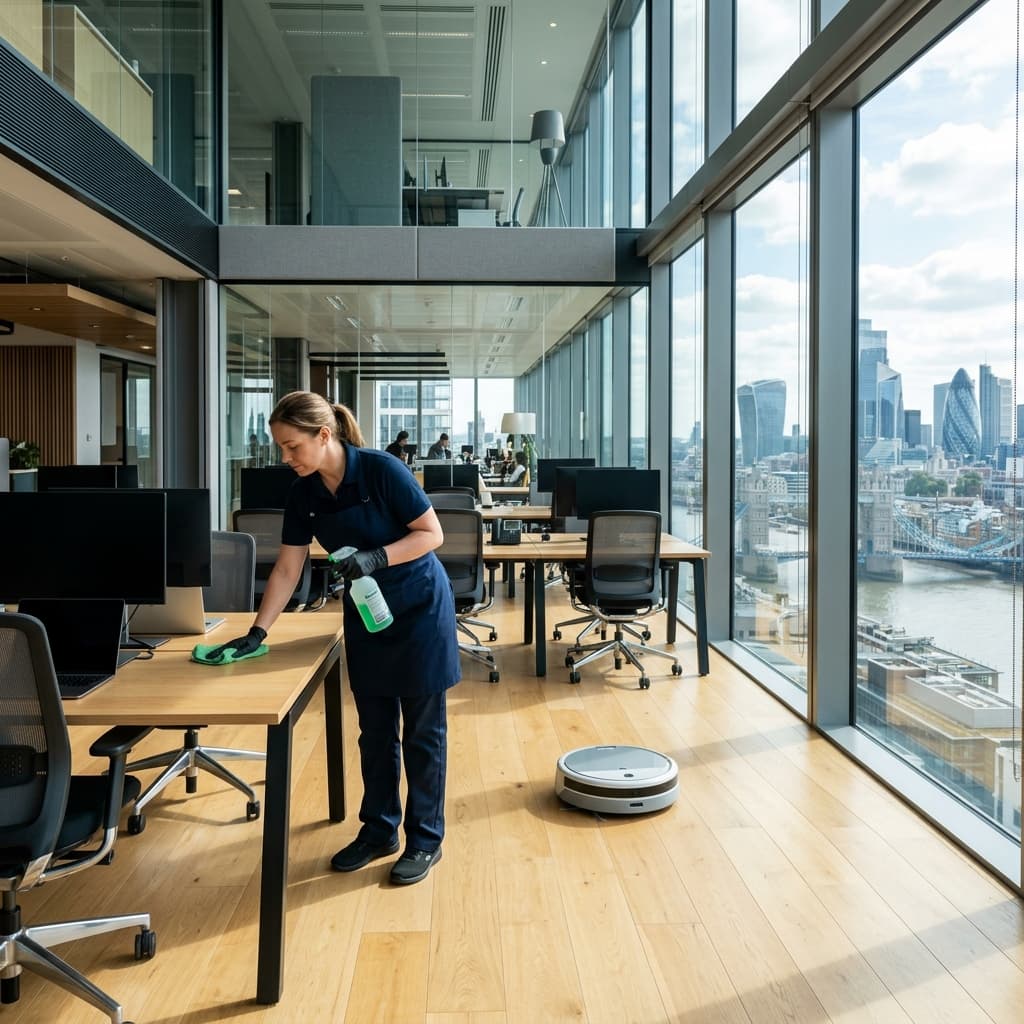
The way London offices are cleaned is changing — and most businesses haven't caught up yet.
Hybrid working, post-pandemic hygiene expectations, rising wage costs, and a genuine shift toward sustainability have all collided at once. The cleaning contract that made sense in 2022 probably doesn't match how your office actually operates in 2026. If you're still paying for the same five-day-a-week clean regardless of occupancy, or accepting paper-based cleaning logs as proof of service, you're behind the curve.
This isn't a piece about gimmicks. These are the trends actively reshaping commercial cleaning contracts across London right now — and what each one means for your business practically.
1. Hybrid Work Has Broken the Old Cleaning Contract Model
The single biggest shift in office cleaning over the past three years isn't a product or a piece of technology. It's a scheduling problem.
Traditional cleaning contracts were built around a predictable office: full occupancy Monday to Friday, same hours every week. That model is gone for most London businesses. Today, most offices run at 70–80% capacity on Tuesday, Wednesday, and Thursday — and as low as 30–40% on Mondays and Fridays.
Cleaning the same way regardless of occupancy wastes money on quiet days and under-cleans on peak ones.
What's replacing it:
| Old Model | Adaptive Model (2026) |
|---|---|
| Fixed 5-day contract | Occupancy-based scheduling |
| Same scope every visit | Intensity scales with usage |
| Monthly reporting | Real-time digital logs |
| Flat monthly rate | Variable billing tied to actual service |
The smarter cleaning companies in London now offer what's essentially a flexible retainer: a minimum service level guaranteed, with scope adjusting based on your calendar. If you have an all-hands day on Wednesday and the office is at 100%, cleaning intensity goes up. If half the team is remote on a Monday, the scope scales down.
If your current provider can't do this, it's worth asking why.
2. Technology Is Finally Making It Into the Cleaning Industry
For a long time, commercial cleaning lagged behind other facility services when it came to technology. That's changing quickly in 2026.
The shift from trust-based to verified service is the most practically significant change. GPS check-in and check-out, time-stamped photo documentation, digital checklists, and IoT-connected sensors in high-traffic areas are replacing the old model where you simply hoped the cleaner showed up and did what the contract said.
For London office managers, this matters for a few reasons:
- Accountability is instant. You can see what was cleaned, when, and by whom — from your phone.
- Issues are flagged before they become problems. Smart dispensers that track soap and paper towel usage, for example, alert facilities teams before supplies run out rather than after someone complains.
- Compliance documentation is automatic. For industries with health and safety reporting requirements, this is no longer a manual admin burden.
Cleaning robots are also moving from novelty to practical tool. Autonomous floor-cleaning machines are now cost-effective for large open-plan offices, warehouses, and atrium-style spaces. They handle repetitive coverage, freeing human cleaning staff to focus on the detailed work that actually requires hands. The robot cleaning market is projected to grow by 22.9% by 2030 — the early-adopters in commercial property management are already seeing the operational benefits.
3. Daytime Cleaning Is on the Rise
For decades, the default was to clean offices outside of working hours — early morning before staff arrived, or evening after everyone left. That model suited businesses that wanted cleaning to be invisible. In 2026, many offices actively want the opposite.
Daytime cleaning is gaining traction for three reasons:
Staff feel safer when they see it happening. Post-pandemic, visible cleaning — someone wiping down the meeting room between uses, restocking the kitchen, sanitising door handles mid-morning — signals that the workplace is being actively maintained. It's not just functional; it affects how people feel about coming in.
Hybrid schedules make evening cleans less logical. If your office empties out at 4pm on Fridays and Mondays, a 6pm clean is wasteful. A mid-afternoon touch-up service aligned to actual departure times makes more financial sense.
It reduces the need for deep intervention cleans. Regular light maintenance during the day means kitchens don't reach the point where a full deep clean is needed as frequently. Prevention is cheaper than cure.
The trade-off is disruption — cleaning staff working around people. The best operators handle this through communication and good service design: structured routes, quiet equipment, and a professional presence that blends into the working day rather than interrupting it.
4. Green Cleaning Has Moved From Optional to Expected
Sustainability used to be a differentiator in commercial cleaning. In 2026, it's increasingly a baseline requirement.
A growing number of London businesses — particularly those operating in financial services, tech, and professional services — now include environmental criteria in their cleaning supplier assessments. This isn't just virtue signalling. Many organisations have scope 3 emissions targets and sustainability reporting obligations that require them to demonstrate responsible supplier choices.
What "green cleaning" actually means in practice:
- Certified eco products. Not just "environmentally friendly" marketing language — look for products with recognised certifications (EU Ecolabel, Cradle to Cradle, Leaping Bunny where applicable).
- Concentrated formulations and refillable dispensers. Reduces plastic waste and transport emissions significantly.
- Microfibre technology. High-quality microfibre cloths and mops clean effectively with dramatically less chemical use — and they're more hygienic, not less.
- Water-efficient methods. Steam cleaning and low-moisture techniques use a fraction of the water of traditional mopping.
- Supplier transparency. Credible providers can show you a product data sheet, a COSHH assessment, and evidence of responsible disposal.
Around 60% of UK businesses now say sustainability factors into their choice of cleaning provider. The practical implication: if you're putting a cleaning contract out to tender, your specification should include environmental criteria — and your current provider should be able to answer detailed questions about their approach.
5. High-Touch Zone Targeting Is Replacing Blanket Daily Cleans
Not every part of an office generates the same level of contamination. A rarely used meeting room used twice a week is not the same hygiene risk as a shared kitchen used by 40 people every day. Treating them identically — cleaning both to the same depth and frequency — is inefficient.
The shift toward targeted, risk-based cleaning is one of the most practically sensible trends in the industry right now.
Highest-priority zones in any London office:
- Shared kitchens and tea points
- Toilet and washroom facilities
- Reception desks and entrance areas
- Meeting rooms with high booking rates
- Lift buttons, door handles, and stair rails
- Shared equipment: printers, coffee machines, scanners
Lower-intensity zones:
- Private offices with a single occupant
- Storage rooms and archive areas
- Infrequently used meeting spaces
- Open-plan desks in areas with hybrid attendance
A well-designed cleaning specification maps intensity to actual risk and usage — which means your high-traffic areas get the attention they need, and you're not paying full rates for spaces that barely need it.
6. Value for Money Is Now the Dominant Buyer Priority
This one is worth stating plainly: in a cost-conscious market, demonstrating tangible value has become the primary concern for both cleaning buyers and providers.
Over 40% of UK facilities managers identified "value for money" as their single biggest priority when assessing cleaning contracts in 2026. That doesn't mean cheap — it means accountable. Businesses want to understand exactly what they're paying for, see evidence it's being delivered, and have a mechanism to address it when it isn't.
For London office managers reviewing their cleaning setup, this means asking hard questions:
- What's actually included in your contract? Can your provider give you a written scope of works with task frequencies and standards?
- How is service verified? Are you relying on self-reporting from the cleaning company, or is there independent evidence?
- When was your contract last reviewed? If your office layout, occupancy patterns, or size have changed in the last two years, your contract probably doesn't reflect reality.
- What does the exit clause look like? Reputable providers offer rolling monthly contracts or fair exit terms. Long lock-ins without performance clauses are a commercial risk.
Value isn't about finding the lowest price per hour. An under-priced cleaning contract almost always means underpaid staff, cut corners, or high turnover — all of which create more problems than they solve. The right question is whether what you're paying is delivering measurable, documented results.
What This Means for Your Office Right Now
These aren't distant predictions. Every one of these trends is already shaping how London cleaning contracts are written, priced, and delivered in 2026.
If you haven't reviewed your office cleaning arrangement in the last 12 months, now is a practical time to do so. The questions worth asking:
- Does your cleaning schedule reflect actual office occupancy, or is it fixed regardless?
- Can your provider demonstrate service digitally, or is it purely trust-based?
- Are the products being used certified and documented?
- Is the cleaning intensity matched to where your office actually needs it?
- Is your contract structured to give you flexibility and accountability?
St Anne's works with London businesses of all sizes to design cleaning arrangements that match how offices actually work today — not how they worked five years ago. If any of the above prompts a review, we're happy to talk through your current setup with no obligation.
Looking for office cleaning that keeps pace with how your workspace actually operates? Get in touch with St Anne's for a no-obligation assessment of your current cleaning needs.
Filed Under:
Want a professional deep clean?
Skip the hassle. Let our 5-star London housekeeping team handle the hard work for you.
Products We Recommend
Vacuum Cleaner (Hoover)
Henry HVR160-11 bagged cylinder vacuum, 6 litre, 620W — the industry-standard commercial hoover.
Colour-Coded Cleaning Cloths
Microfibre cloths in four colours, so bathroom, kitchen and general-area cloths never get mixed up.
Zoflora Disinfectant
Zoflora Midnight Blooms multipurpose disinfectant trigger spray.
Method All-Purpose Cleaner
Method all-purpose cleaner spray, Deep House, cuts through grease.
Purdy & Figg Counter Clean
Purdy & Figg Counter Clean refill, all-purpose spray.
HG Mould Spray
HG mould remover spray, kills black mould and mildew.
Contains Amazon affiliate links. Learn more.
Table of Contents
Products We Recommend
Vacuum Cleaner (Hoover)
Henry HVR160-11 bagged cylinder vacuum, 6 litre, 620W — the industry-standard commercial hoover.
Colour-Coded Cleaning Cloths
Microfibre cloths in four colours, so bathroom, kitchen and general-area cloths never get mixed up.
Zoflora Disinfectant
Zoflora Midnight Blooms multipurpose disinfectant trigger spray.
Method All-Purpose Cleaner
Method all-purpose cleaner spray, Deep House, cuts through grease.
Purdy & Figg Counter Clean
Purdy & Figg Counter Clean refill, all-purpose spray.
HG Mould Spray
HG mould remover spray, kills black mould and mildew.
Contains Amazon affiliate links. Learn more.
Our Cleaning Services
Professional cleaning services across London — book yours today

Deep Cleaning Services
Intensive deep cleaning for spring cleans, move-ins, or one-off thorough cleans covering areas beyond regular house cleaning.

End of Tenancy Cleaning
Professional end of tenancy cleaning in London guaranteed to pass landlord inspections and secure your deposit return.

Carpet Cleaning London
Expert carpet cleaning services across London using advanced equipment to remove deep stains and eliminate odors.